From possibility to experience
The cost of changing an idea increases as it becomes real.
Early on, almost anything is possible. The work is to narrow that possibility without prematurely committing to a solution.
Framing establishes the problem and the outcome worth pursuing. Shaping explores possible solutions, exposes unknowns, and makes the tradeoffs necessary to choose a direction.
Only then does it make sense to commit significant time and resources.
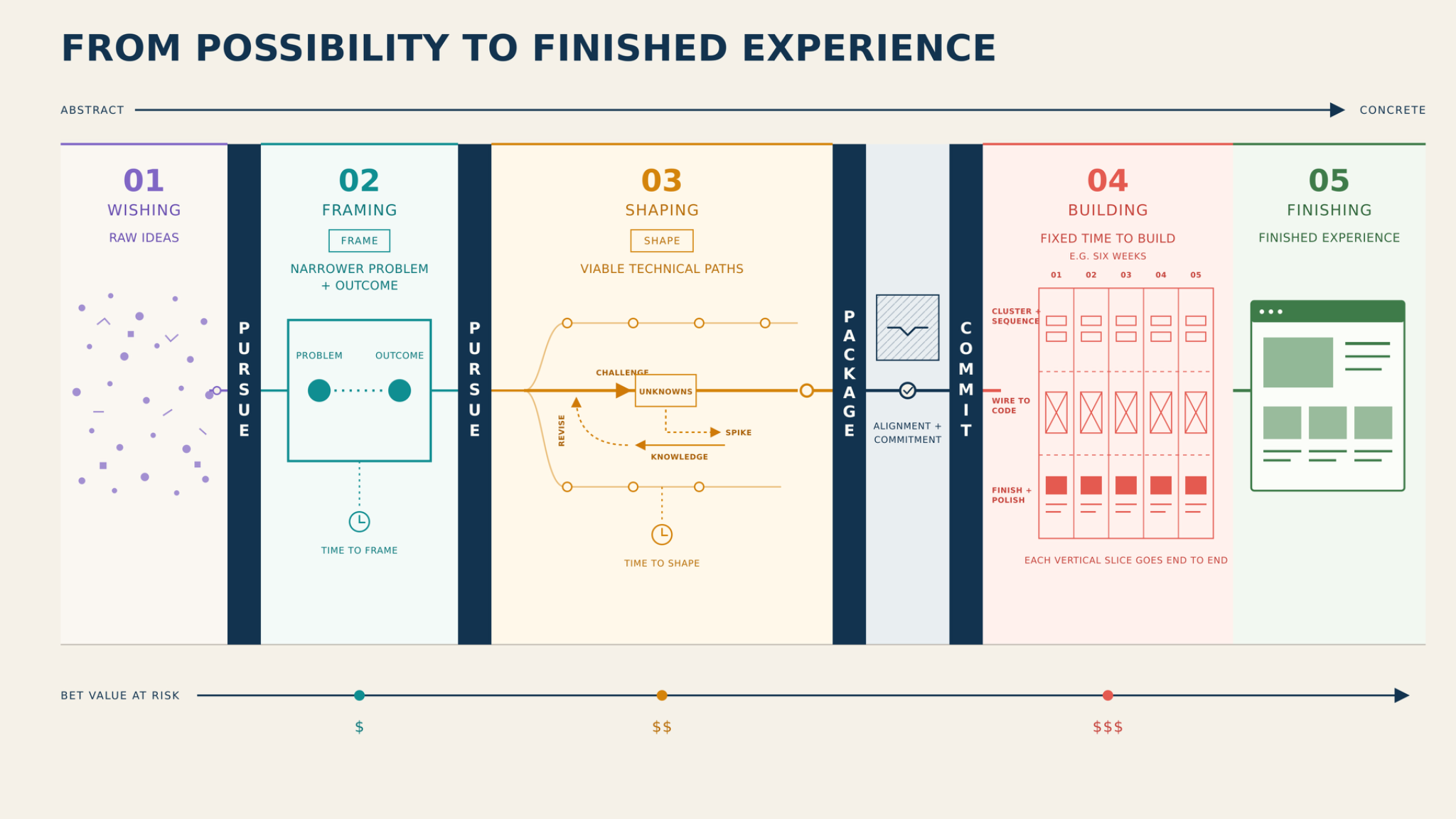
Building turns that commitment into working software. Finishing turns working software into a coherent experience. They are not the same thing.
The process is not strictly linear. Discovery continues throughout. But the nature of the decisions changes as more is invested.
The principle is to reduce consequential uncertainty before increasing commitment, while preserving enough flexibility to learn from the work itself.
The goal isn't simply to build something. It's to arrive at something worth having built.