Before designing a solution, we need to understand the space it must occupy.
That space has a form.
It emerges from the situation we're trying to change, the outcome we want, the gap between them, and the constraints we must respect. Together, these give us criteria for judging whether a proposed solution fits.
These criteria are not the solution itself. They describe what an acceptable solution must accomplish or preserve without necessarily prescribing how.
This distinction matters. When a requirement already specifies a mechanism, we may have chosen a solution before understanding the problem. A useful test is whether several different approaches could plausibly satisfy the same requirement.
Once the criteria are clear enough, we can compare candidate designs against them. This is the first Fit Check: which overall shape best satisfies what we've established matters?
But choosing a shape leaves another question unanswered.
Why do its particular parts belong?
Rotate the matrix. Keep the requirements fixed, but replace the competing solutions with the parts of the selected one.
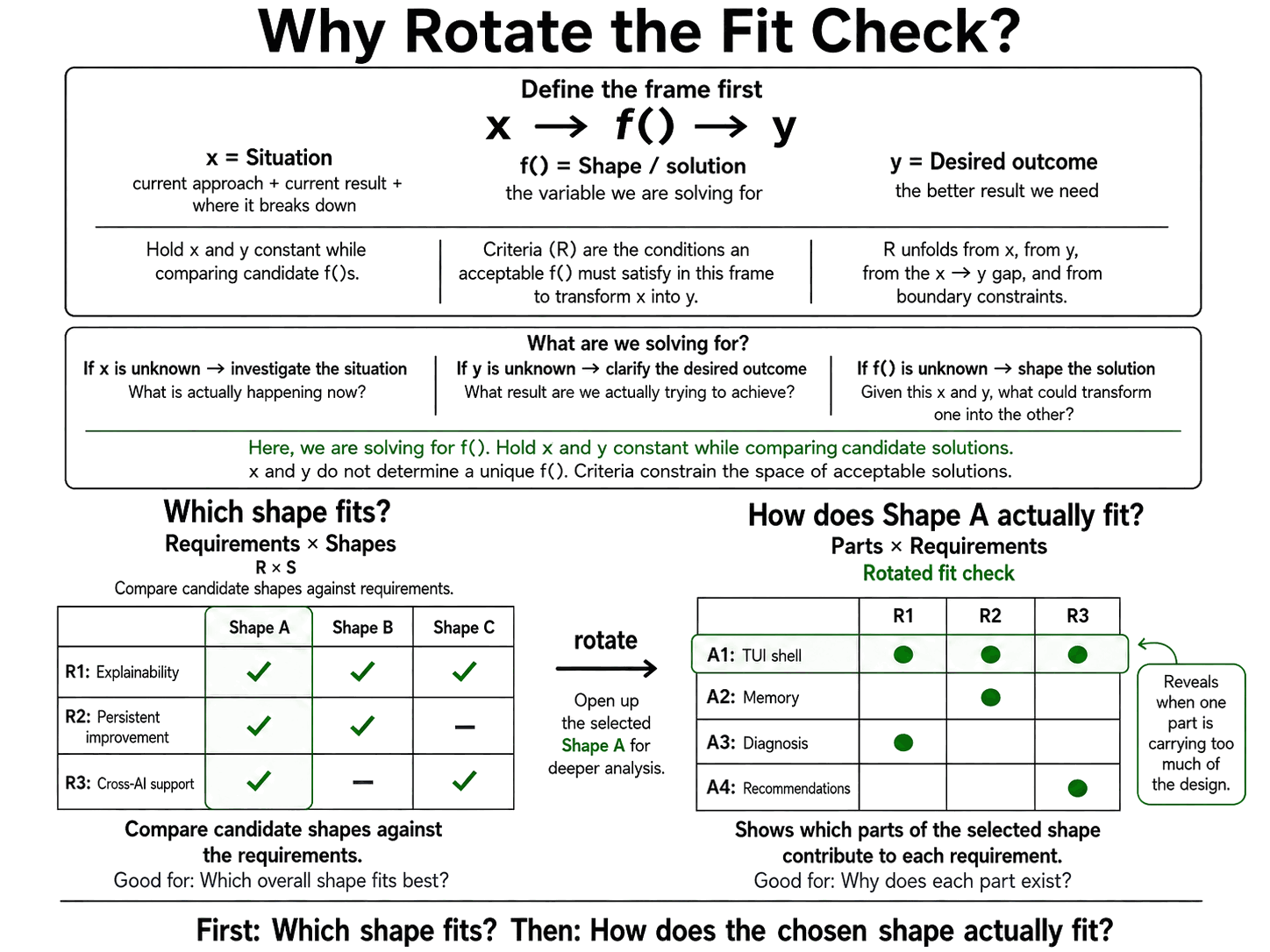
The Fit Check compares candidate shapes. Rotating it reveals how the selected shape's parts contribute to the requirements. Select the image to view it at full resolution.
Now we can see which requirements each part supports, where responsibilities overlap, and where something essential may be missing. We can question whether a part is necessary, whether its responsibilities belong together, or whether another arrangement would satisfy the same requirements more simply.
The first view helps us choose among possible wholes. The second helps us understand and improve the internal relationships that make a chosen whole work.
Neither view makes the original criteria infallible. Designing and testing a solution may reveal that we misunderstood the situation or overlooked a requirement. When that happens, we return to the frame and revise it deliberately.
Good design isn't only about giving form to a solution. It's also about discovering the form of the problem it must solve.
And once we've chosen a form, understanding why each part belongs.