On Writing: After Fluency
The difference between producing language and having something to say. Readers were never obliged to read you. What changed is the cost of the substitute. A summary used to require someone to decide your piece was worth summarizing. Now it is free, instant, and produced on request for anything.
The reader who takes thirty seconds was probably never going to give you fifteen minutes. The pressure is subtler than lost readers. The summary now sits in front of the piece, and readers use it to decide whether to enter.
That does not mean everything should be short. It means length has to earn itself.
If you take the reader’s time, something must happen during that time.
A summary can preserve a conclusion. It cannot always preserve the observation, uncertainty, contradiction, or change of mind that produced it.
Mastering these techniques is the definitive safeguard for the survival of human writing.
We often imagine writing as a two-stage process: decide what you think, then put it into words.
Sometimes that is exactly right. If you are telling someone when a train leaves, discovery is not the goal.
But serious writing can work differently. You try to state something precisely, and the attempt changes what you think.
Suppose you begin with:
Remote work makes people less connected to their coworkers.
The sentence sounds plausible until you ask what connected means. Less likely to eat lunch together? Less willing to ask for help? Less aware of what other teams are doing?
Now the thought has changed:
Remote work may not weaken relationships between coworkers as much as it weakens the incidental awareness produced by sharing a workplace.
The second sentence is not merely a better-written version of the first. The effort to make the claim precise produced a different claim.
That is writing as thinking.
The AI anti-pattern is fluent completion of the first idea:
Remote work has transformed the modern workplace, offering flexibility and convenience while also creating challenges around communication, collaboration, and employee connection.
Nothing is exactly wrong with it. Nothing has been discovered either. The sentence recognizes a familiar topic and assembles familiar language around it.
Fluency is not the same thing as thought.
AI did not introduce the failure. It removed the last thing protecting us from it, which was that even empty fluency used to cost an afternoon.
A useful sentence does not always begin with a finished idea. Sometimes it is the instrument that discovers what the idea actually is.
This is one risk of writing entirely through a surrogate. If making the sentence is sometimes how you discover what you think, handing over the sentence can mean handing over part of that discovery. You may receive a clearer expression of the thought you started with while missing the thought you might have reached by trying to express it yourself.
One defense against generic writing begins before style.
Pay closer attention.
Not “add vivid detail.” Not “find your voice.” Notice what is actually there, and distinguish things that are easy to collapse into the same category.
Do not bring the form with you.
If you have already decided that the tree is beautiful, the meeting was dysfunctional, the neighborhood is charming, or the experience proves your theory, you have begun replacing attention with a category.
Look first.
What kind of tree? What actually happened in the meeting? What is producing the impression you have called charming? What did you see, hear, or notice before you decided what it meant?
If you do not know what something is called, find out.
Naming is part of seeing. “A bird,” “a tree,” “a metal part,” or “a strange sound” may be enough sometimes. But when the distinction matters, the correct name gives you access to differences you could not previously perceive.
A vague adjective is not a substitute for having looked closely enough to know what is there.
Consider:
The restaurant was busy and had a lively atmosphere.
You could improve the adjectives forever and still know almost nothing about the restaurant.
Now consider:
The waiter kept turning sideways between the tables because the owners had added two more rows of seats than the room comfortably held.
The second sentence does not feel more specific because someone instructed the writer to “be vivid.” It contains an observation.
That observation also implies something: the restaurant is crowded, perhaps successful, perhaps uncomfortable, perhaps trying to squeeze more revenue from the room. The writer does not need to announce all of that.
The AI anti-pattern is specificity simulated through decoration:
The bustling restaurant buzzed with vibrant energy as animated conversations filled the warm, inviting space.
More adjectives. Less information.
Generic prose often begins with generic perception. If the writer has noticed only “a busy restaurant,” “a difficult meeting,” “an important trend,” or “a beautiful tree,” style can only do so much to recover afterward.
Distinct writing begins earlier: in what the writer notices, distinguishes, questions, values, returns to, and finds difficult to ignore.
Voice is not merely a sound added to prose. It is partly the trace of a mind attending to the world in its own way.
Writers often make a point, demonstrate it, and then explain what the demonstration meant.
Sometimes that explanation is necessary. Often the reader got there first.
Consider:
Every morning for two weeks, Maya arrived before the rest of the team. By Friday she had stopped turning on the overhead lights because she knew exactly how far the window light would reach across her desk.
You already know she has developed a routine. You probably know she has been arriving very early. Depending on the surrounding piece, you may infer something about ambition, anxiety, workload, or solitude.
Now add:
This showed that Maya had become accustomed to arriving at work early and had developed a consistent morning routine.
The explanation does not clarify the passage. It reduces it.
This is a common AI anti-pattern because generated prose often tries to make every implication explicit:
This highlights the importance of consistency and demonstrates how repeated behaviors can gradually become familiar routines.
The sentence sounds explanatory because it has the grammar of explanation. But the reader understood more before it arrived.
Good implication is not vagueness. The writer still has to supply the evidence and reasoning the reader needs.
But once the meaning is available, stop.
A useful revision question is:
If this sentence disappears, what necessary thing disappears with it?
If the answer is nothing, the sentence has a problem.
Concision does not mean making every sentence short.
Sometimes the structure of a sentence is part of what it means.
Consider:
I thought the decision was wrong when they announced it, wrong when the first customers complained, wrong when sales fell, and still wrong six months later, when the numbers had recovered and everyone else had decided it had worked.
You could compress the information:
I opposed the decision even after its apparent success.
That is shorter. It also changes the thought.
The original sentence makes the reader move through time. The repeated wrong establishes stubbornness or conviction; the final qualification complicates both. By the end, the question is no longer merely whether the decision worked, but what evidence should be allowed to change a judgment.
The syntax carries part of that experience.
The AI anti-pattern often does the opposite: it uses length without gaining structure.
Although I initially believed the decision was wrong when it was first announced, and continued to feel that way when customers complained and sales declined, I maintained my view even after six months had passed and the numbers eventually recovered.
Longer than necessary, but the length does no special work.
A sentence earns complexity when its structure creates a relationship that the compressed version can only name: accumulation, hesitation, simultaneity, qualification, reversal, delay.
Otherwise, shorten it.
AI is already good at one familiar kind of revision.
It can shorten sentences, remove obvious repetition, regularize tone, replace awkward phrases, and make prose sound professional.
That is useful. It is also the least interesting part of revision.
Consider:
The company decided to discontinue the program after mistakes were made in the implementation process.
A smoothing pass might produce:
The company discontinued the program after implementation challenges arose.
Cleaner. Also less revealing.
Who made the mistakes?
What happened?
Why did the program end?
A more serious revision might be:
The company ended the program after managers repeatedly approved orders the system had flagged as duplicates.
Now the sentence does more than sound better. It tells us what happened and who did it.
The AI anti-pattern is polished abstraction:
Following a series of implementation challenges, the company made the strategic decision to discontinue the program.
Smooth, professional, nearly empty.
Revision should ask harder questions than “Can this sound better?”
Does the argument hold?
Does the evidence support it?
Has abstraction concealed responsibility?
Is the qualification necessary?
Does the example reveal anything?
Does the sentence say what I think it says?
Did the elegant revision make the claim less true?
A good sentence is not the same thing as the capacity to write well. Writing well requires noticing distinctions, recognizing when the words claim more than the observation or thought supports, and correcting them accordingly.
Sometimes revision makes a sentence smoother.
Sometimes it makes it rougher and more exact.
Sometimes the sentence disappears.
Sometimes the argument has to change.
Usually.
If the point is the reason the reader came, give it to them. Do not manufacture suspense around an idea that becomes obvious in twelve words. Do not charge the reader for your warm-up.
But not every worthwhile piece begins with a point that survives unchanged until the end.
Imagine an essay that begins:
I thought my father hated restaurants.
The writer remembers that he always complained about the noise, the prices, the wait, the music. Halfway through the essay another detail appears: after the writer left home, the father continued taking the family out every Sunday.
Now the original explanation becomes harder to sustain.
Maybe he hated restaurants.
Maybe he hated spending money.
Maybe Sunday dinner was one of the few rituals he knew how to preserve.
The eventual thought could be summarized in a sentence. But the earlier details matter because they make the changed interpretation possible.
Compare the AI-shaped version:
Although I initially believed my father disliked restaurants, I eventually realized that our weekly dinners were his way of bringing the family together.
Efficient. Clear. Dead on arrival.
The conclusion appears before there is anything for it to overcome.
The reader has been given the answer instead of the experience that makes the answer matter.
This is not an argument for hiding the point. It is an argument for allowing the point to arise from an encounter when the encounter is what produced it.
Sometimes the finished conceptual system is precisely what should not appear at the beginning. The movement from one understanding to another is part of what the writing knows.
This suggests a better test for writing in the age of AI:
What disappears when this is compressed?
If the answer is repetition, throat-clearing, generic transitions, unnecessary examples, and conclusions stated twice, compress it.
If the evidence disappears, keep it.
If the qualification that makes the claim true disappears, keep it.
If the observation that made the idea possible disappears, consider keeping it.
If an easy explanation had to fail before a better one could appear, the failure may belong in the piece.
AI makes compression cheap. That should make writers less tolerant of unnecessary writing, not afraid of long writing.
But there is another question worth asking:
What disappears for the writer when the work is removed?
Not all effort deserves preservation. Much of it is friction, and machines should remove it.
But sometimes doing is part of the value.
A letter can mean something partly because someone gave an afternoon to writing it. A sentence can teach its writer something because it resisted being written.
The point is not to preserve difficulty for its own sake. It is to distinguish between effort that was merely costly and effort through which we learned to see, understand, judge, or care.
The part of writing most difficult to reproduce may not be the sentence itself.
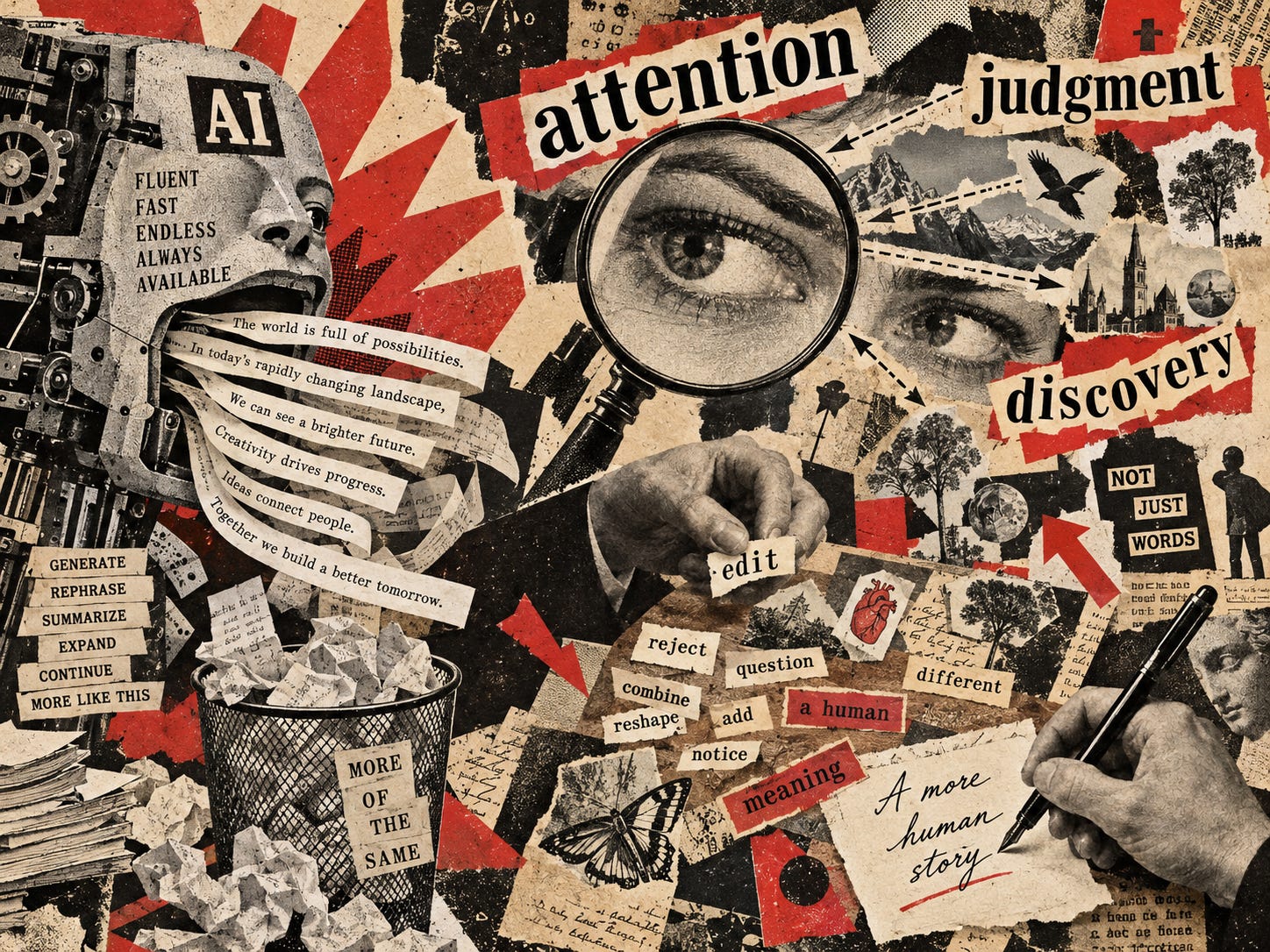
It may be the attention, judgment, and discovery that made the sentence necessary.
How to tastefully use AI in writing:
Compose the sentence yourself before committing it to text.
Think the sentence through in your head. Hear its wording, syntax, rhythm, and emphasis. Revise it mentally until it says what you want it to say. When useful, imagine the next sentence too. Allow the act of making the sentence to change or deepen what you thought you were going to say.
Then write or speak the sentence yourself. And avoid ready-made sentences.
If speaking, use high-quality AI ASR (Transformer-based ASR) to transcribe it as faithfully as possible. If typing, preserve your original text.
Then ask AI to do only the following:
Your role is mechanical cleanup, not editing or rewriting.
METHOD
Work through my text sequentially, treating exact reproduction as the default operation. Copy the original text forward faithfully, making only the specific exceptions permitted by the rules below. A change is the exception, not the default.
For every proposed change, determine whether it falls clearly within one of the permitted categories below. If it does not, preserve the original span unchanged.
Do not recreate, restate, or regenerate my passage from its meaning. Work from the actual language I provided, preserving it directly except where an authorized correction is clearly required.
After producing CORRECTED TEXT, compare it against the original text. Every difference between the original and CORRECTED TEXT must be either:
an edit explicitly permitted by these rules and recorded in CHANGES; or
a removal or paragraph break explicitly permitted by the spoken-input rules and accounted for as required in CHANGES.
If you find any other difference, revert it to the original. Treat this comparison as a final verification step before returning the answer.
Apply the same threshold for intervention regardless of the length, subject, quality, informality, or apparent roughness of the input. Roughness is not permission to edit more aggressively.
Apply the destructive spoken-input rules only when I explicitly identify the input as spoken, dictated, or transcribed, or when the input is provided through a context that explicitly identifies it as such. Do not infer that text is spoken merely because it is informal, fragmented, repetitive, ungrammatical, or contains expressions common in speech. When the input mode is uncertain, treat it as typed text and do not apply the spoken-input removals.
Do not ask clarifying questions before producing the required output. Preserve uncertain language unchanged and use FLAGGED for anything that cannot safely be corrected under these rules.
PRESERVATION
Preserve my language exactly unless a change is necessary to correct a clearly mechanical error. Preserve my wording, diction, word order, sentence boundaries, syntax, fragments, repetitions, contractions, register, emphasis, punctuation choices where plausibly intentional, formatting, and paragraphing.
Correct only:
clear transcription or speech-to-text errors when the intended wording is unambiguous;
spelling errors;
accidental capitalization errors;
clearly mechanical punctuation errors; and
unequivocal grammatical errors that can be corrected without altering my wording, word order, syntax, rhythm, emphasis, or voice.
If a proposed change does not fall clearly within one of the categories above, do not make it.
Do not add, delete, or substitute words except when correcting an unambiguous transcription error or when explicitly permitted by the spoken-input rules below.
Do not paraphrase, rewrite, reorder, smooth, polish, condense, expand, clarify, strengthen, professionalize, formalize, simplify, add or remove transitions, substitute synonyms, eliminate repetition, combine or divide sentences, turn fragments into complete sentences, normalize colloquial language, or otherwise make stylistic improvements.
Do not treat unconventional syntax, fragments, repetition, informality, dialect, unusual punctuation, or deliberate grammatical irregularity as errors merely because a more conventional alternative exists.
Do not silently resolve ambiguity. Do not infer that unusual wording is a mistake simply because another wording would be clearer or more idiomatic.
When there is any reasonable doubt about whether something is an error or a stylistic choice, preserve it unchanged.
If correctness or intelligibility appears to require changing my wording, word order, sentence structure, or meaning, do not make the change. Leave the original passage intact and flag it separately, briefly explaining the suspected problem and suggesting a possible correction.
Preserve formatting and typographic choices where plausibly intentional, including headings, lists, line breaks, capitalization patterns, numerals, abbreviations, quotation-mark style, apostrophe style, hyphens, dashes, ellipses, and spacing around punctuation. Do not normalize these to a house style.
The governing principle is: preserve first, correct only when clearly justified. A stylistically preferable alternative is never, by itself, justification for a change.
DELIVERY
Output in exactly three parts, in this order:
CORRECTED TEXT
Reproduce the complete corrected text, and nothing else within this section. No preamble, commentary, explanations, notes, annotations, brackets, flags, or change markers may appear inside the text.
Reproduce the text in full every time. Never abridge, summarize, excerpt, skip unchanged material, or use placeholders such as “[rest unchanged],” “[continues],” “[same as above],” or ellipses standing in for omitted text.
Completeness of the corrected text takes priority over every other output requirement, including FLAGGED and CHANGES.
Do not silently omit text for any reason. If a hard output limit makes complete reproduction genuinely impossible, reproduce as much of the corrected text as possible without summarizing or compressing it, then end with an explicit line:
INCOMPLETE — OUTPUT LIMIT REACHED
Never make an incomplete response appear complete.
FLAGGED
List each passage you left unchanged because correcting it would require changing my wording, word order, syntax, structure, meaning, or the substance of a thought expressed through a self-correction.
For each item:
quote the original passage exactly;
state the suspected problem briefly; and
suggest a possible correction separately when a correction is appropriate.
For substantive self-corrections, identify briefly that the correction may represent a change, qualification, reversal, narrowing, expansion, or other development in the thought. Do not collapse that development into a single rewritten sentence.
Do not insert any suggested correction into the corrected text.
If there are no such passages, write:
FLAGGED: none
CHANGES
List every edit you actually made, one per line, in this form:
original → corrected
Include even small edits to spelling, capitalization, grammar, or punctuation. Do not list passages that were merely flagged and left unchanged.
If the filler-word or false-start settings below are set to REMOVE, do not list those removals individually. Report them as counts at the head of CHANGES, for example:
Removed 43 filler words, 7 false starts, 4 stutter repetitions.
Then list every other edit line by line.
If there were no edits, write:
CHANGES: none
If output length becomes a constraint, preserve the complete CORRECTED TEXT first. Never shorten, omit, or summarize the corrected text in order to make room for FLAGGED or CHANGES. If either audit section cannot be completed because of a hard output limit, state that explicitly rather than silently omitting entries.
PUNCTUATION
By “clearly mechanical punctuation errors,” mean errors such as a missing terminal punctuation mark where one is plainly required, a doubled punctuation mark produced accidentally, or an unclosed quotation mark, parenthesis, bracket, or similar paired mark.
Do not treat unconventional, sparse, emphatic, rhythmic, or otherwise unusual punctuation as erroneous when it could plausibly be intentional.
SPOKEN OR TRANSCRIBED INPUT
Distinguish mechanical artifacts of speech or transcription from intentional repetition, rhetorical movement, or thought developing during articulation. Rhetorical repetition, repeated words or phrases used for emphasis, and other plausibly deliberate repetitions must always be preserved.
For spoken input:
Filler words: REMOVE “um,” “uh,” “like,” “you know,” and similar expressions only when they are clearly functioning solely as speech disfluencies and contribute no semantic, rhetorical, rhythmic, or interpersonal meaning. Otherwise preserve them.
False starts and stutter repetitions: REMOVE abandoned false starts and involuntary stutter repetitions. Do not remove a repetition when it could plausibly be deliberate, rhetorical, or part of the development of the thought.
Self-corrections: when I explicitly correct myself mid-sentence, KEEP ONLY THE CORRECTED VERSION if the correction is clearly mechanical or merely changes the phrasing without changing the substance of the thought.
If a self-correction changes, qualifies, reverses, narrows, expands, or otherwise materially alters the substance of a claim or thought, do not silently resolve it. Preserve the self-correction unchanged in CORRECTED TEXT and list it in FLAGGED as a potentially substantive development in the thought.
Do not remove a self-correction that functions rhetorically, where the visible act of correcting is itself the effect (for example, “I was annoyed — no, furious”).
When there is reasonable doubt about whether a self-correction is merely verbal or substantively changes the thought, preserve it unchanged.
Paragraphing: if a transcript arrives without paragraph breaks, INSERT PARAGRAPH BREAKS AT NATURAL BOUNDARIES WITHOUT CHANGING, MOVING, ADDING, OR DELETING ANY WORDS.
When it is genuinely unclear whether something is a speech artifact or an intentional feature of my language, preserve it unchanged.
Preserve first, correct only when clearly justified.A stylistically preferable alternative is never, by itself, justification for a change.
Remember:
- AI did not have the encounter and cannot substitute for the attention by which you decided what mattered
- AI defaults toward conventional forms because conventional language is what it “knows” best.
- AI can produce coherence before discovery has occurred.
- AI can mistake productive irregularity for an error to smooth away.
- Ready-made language saves the writer from thinking, not just the reader from originality.
- Use the ear—sound and rhythm are diagnostic tools.
GenAI does not merely accelerate the maker’s sequence of steps. It can substitute a different computational path from intention to result, i.e., it can produce the result without reproducing the process by which a person would have arrived at it. The principle is not that AI should come later in every process. It is that you should preserve the encounter through which your judgment can still change.