Reality Is Relations Stabilizing Into Things
The Emergent Layered Ontology
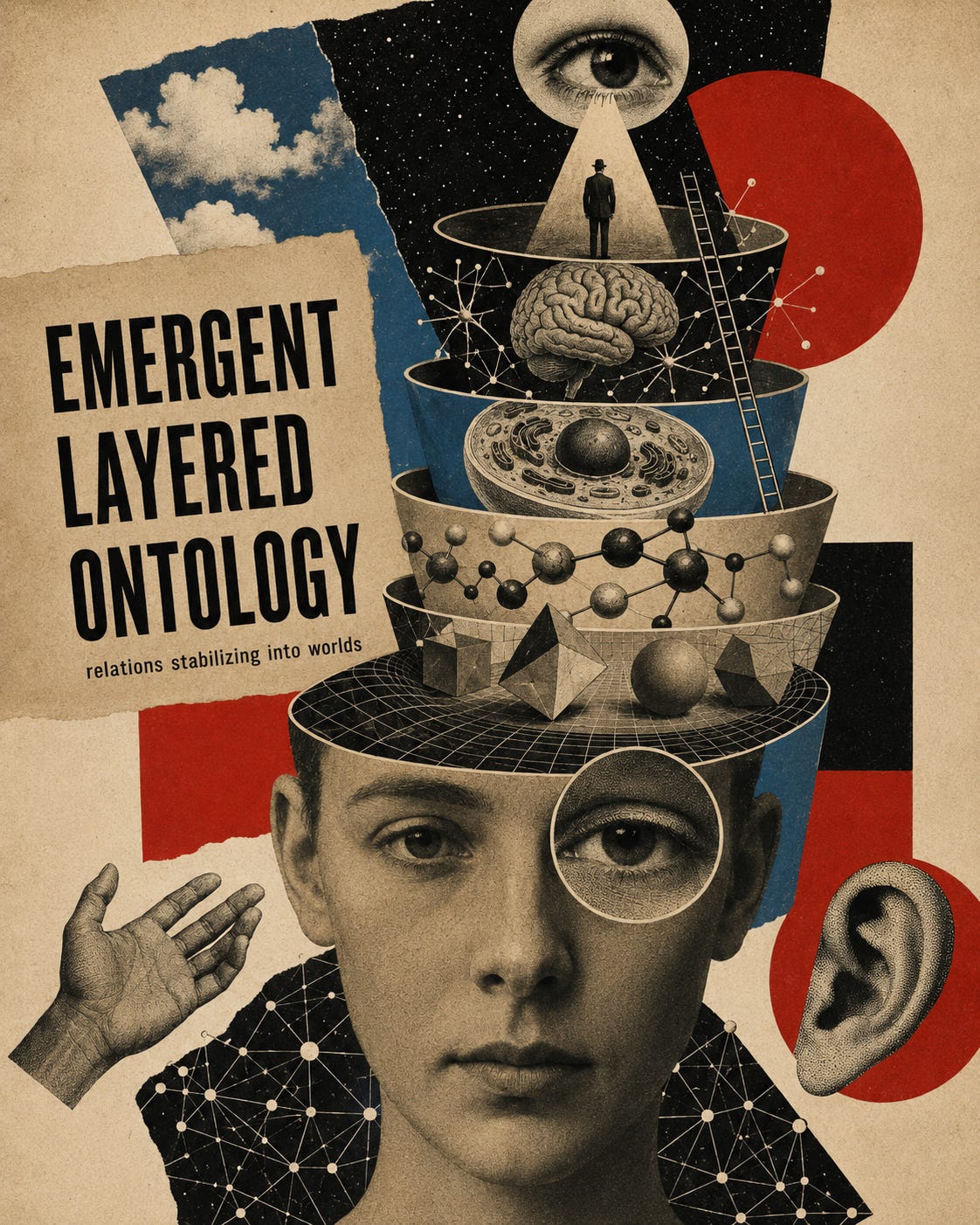
Let’s start by rejecting the oversimplified debate:
Is reality fundamentally made of matter, information, bits, particles, fields, or spacetime?
The better answer is not to pick one layer and declare victory. A bit and the Planck scale are not rival foundations. A bit belongs to the logic of distinction. The Planck scale belongs to the logic of physical measurement and limit. These may be connected, but one does not obviously eliminate the other.
The deeper question is not: Which layer is really real?
The deeper question is: How do stable layers of order become instantiated in one another?
Reality is not first made of isolated things. It is made of relations, constraints, differences, dependencies, and possible transformations that stabilize into things.
Objects are not the foundation. Objects are stable patterns.
Space, matter, chemistry, life, mind, and perception are not separate substances. They are layered modes of organization within one structured reality.
By information, I do not mean human knowledge, computer data, or symbols in a mind.
I mean physically real structure: the pattern of distinctions and constraints that determines what states are possible, how they can differ, and how they can transform.
A thing is what it is because it has determinate structure. It differs from what it is not. It can enter some relations and not others. It can change in some ways and not others.
That is the informational sense of reality: constrained distinguishability.
Modern physics already gives us reasons to doubt the picture of reality as little self-contained things sitting in empty space.
Quantum entanglement shows that systems do not always have fully independent local states. In some cases, the relation is not added after the parts. The relation helps define what the parts are.
In some approaches to quantum gravity, spacetime geometry itself appears connected to patterns of entanglement. This does not prove that “everything is information,” but it gives serious motivation for thinking that space may not be a primitive container. Space may be an emergent geometry of deeper relational structure.
So the physical world may not begin with objects in space.
It may begin with structured relations from which space-like order emerges.
If space is an emergent geometry of relations, matter need not be primitive “stuff” added on top.
Matter can be understood as stable disturbance, excitation, or localized pattern within deeper physical structure.
A particle, on this view, is not a tiny bead of substance. It is a repeatable, stable way the underlying structure behaves.
This gives us the first bridge:
Relations stabilize into geometry. Geometry supports disturbances. Stable disturbances appear as matter.
The clearest example of layered reality is life.
Chemical reactions become biological when they are organized into systems that preserve boundaries, regulate internal conditions, repair themselves, metabolize energy, and maintain homeostasis.
ATP hydrolysis, ion gradients, diffusion, osmosis, and protein shape changes are chemical processes. In isolation, they are not “life.” They are not “homeostasis.” They are not “survival.”
But inside a membrane-bounded self-maintaining system, those chemical processes acquire biological function.
Chemistry explains what is happening locally.
Biology explains why those processes matter to the persistence of the whole organism.
This is the crucial move: the higher layer does not violate the lower layer. It organizes it.
Biology depends entirely on chemistry, but it introduces a new logic: regulation in service of continued life.
This is also true outside biology.
Chess is physically instantiated in wood, plastic, screens, or silicon. But chess is not explained by wood alone.
Spotify is physically instantiated in circuits, servers, protocols, and electrical states. But Spotify is not explained by electrons alone.
The higher-level reality is not unreal just because it depends on a lower-level substrate.
The important question is how stable interfaces allow one layer of order to become operative within another.
That is how chemistry becomes biology.
That is how matter becomes mind.
Consciousness is not merely integrated information.
It is integrated information inside a self-maintaining organism for whom differences matter.
A living system does not process signals neutrally. It processes signals in relation to its own continued existence.
At the neural layer, the organism builds fast, integrated, predictive models of its body and environment so it can act before it dies.
At the conscious layer, the model is no longer merely information about the world.
It is the world as it matters to this organism, from the inside.
Sodium ions do not contain pain.
Neurotransmitters do not contain suffering.
A nociceptor does not contain “hurt.”
But when bodily signals are integrated into a living body-model whose function is self-preservation, the signal is no longer neutral.
It becomes bad-for-me-now.
That is the ontological jump.
Signal becomes meaning when it is interpreted by a self-maintaining system.
Meaning becomes feeling when it concerns the state of the system itself.
Feeling becomes consciousness when those state changes are integrated into a unified point of view.
The brain is not merely a lump of matter. It is matter organized into an extraordinarily dense, self-modifying, self-modeling information structure.
The brain is what consciousness looks like from the outside.
Consciousness is what that integrated living structure feels like from the inside.
They are not two substances.
They are two perspectives on one organized process.
The world we perceive is not necessarily reality in its raw form.
Biological perception evolved for adaptive navigation, not for metaphysical transparency.
Our senses do not need to show us the deepest structure of reality. They need to present a usable world: objects, colors, sounds, space, solidity, bodies, distances, threats, tools, and opportunities.
The physical world we experience is real as experience and useful as representation.
But it may not be fundamental.
It may be an organism-level interface over deeper relational structure.
Reality is not made first of things.
It is made of relations that stabilize into things.
At one level, those relations appear as space, matter, and fields.
At another, as chemistry.
At another, as life.
At another, as consciousness.
Underlying reality may be best understood as a mathematical-information structure: not information as data in a computer, but information as constrained distinguishability, relation, and possible transformation.
Space is an emergent geometry within it.
Matter is a stable excitation of it.
Life is self-maintaining organization within it.
Mind is the felt interior of living information organized around self-preservation.
The world we perceive is the interface through which such a system navigates the deeper structure that made it possible.