What Human Practice Is For
AI may make human labor unnecessary. That does not make human participation unnecessary.
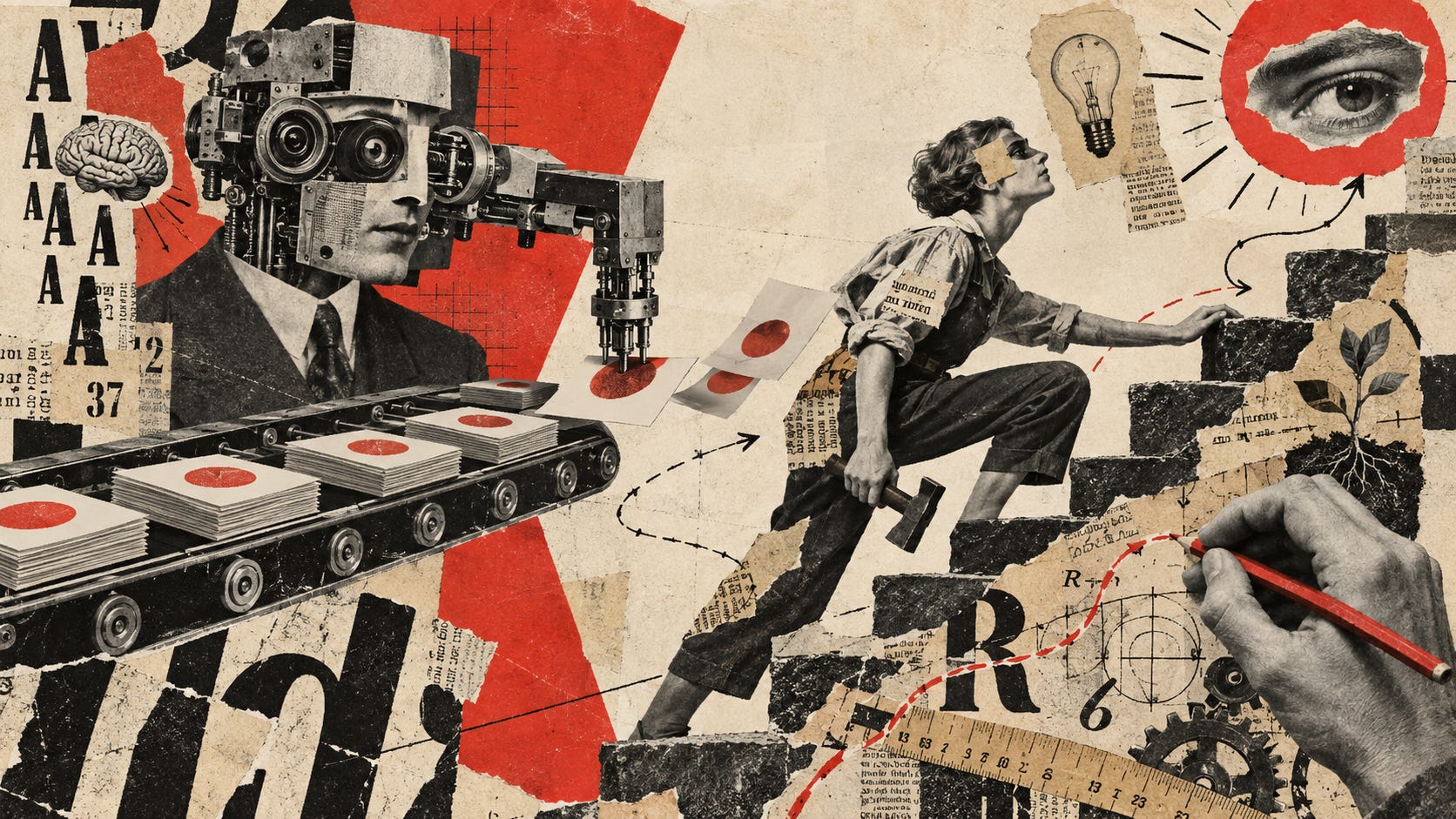
If AGI can eventually do anything a person can do as well as a person can do it, one arrangement seems obvious. We decide what we want. The machine produces it. We inspect the result and decide whether it is good.
For a great deal of work, that will be an improvement. If I need a calculation, I usually want the answer, not the experience of calculating it. If a machine can perform a repetitive transformation faster and with fewer errors, there is no virtue in making a person repeat it instead.
The harder cases begin when we are less certain about what we want.
You sit down to write something because you think you know the argument. Then a sentence will not work. You change the sentence, but the problem remains. Eventually it becomes clear that the trouble is not the wording. Two ideas you had treated as the same are different, or a premise you were relying on does not quite survive being stated plainly. The writing has told you something about the thought.
Something similar happens when building software. A feature can look straightforward in a specification and become strange once it has to live inside an actual system. A dependency turns out to matter. Two states that seemed equivalent are not. The supposedly minor exception becomes the thing the design has to be organized around.
In cases like these, implementation is not merely the conversion of a finished idea into a finished product. It is part of finding out what the idea requires.
The usual argument for delegation quietly assumes otherwise. It imagines work as a route from intention to outcome: first we determine the destination, then we pay the cost of getting there. If the destination is known and the path teaches us nothing we care about, shortening the path is mostly gain.
But many things we do are not like that. We learn where we are going partly by going.
This is not a reason to preserve every intermediate step. Much of what people currently do is accidental friction: copying information between systems, waiting for an approval that adds nothing, fighting a badly designed tool, performing some mechanical operation for the thousandth time. We lose very little when these disappear.
The difficulty is that useful resistance and useless friction do not always announce themselves in advance.
Two frustrating afternoons can feel almost identical while you are inside them. In one, you are wasting time because the tool is badly made. In the other, the thing you are trying to do is exposing a flaw in your understanding. Only afterward may it become clear that one obstacle should have been removed and the other was where the learning happened.
“Preserve the useful parts,” then, is less useful as a rule than it first appears. Often the value of a difficulty becomes visible only after it has changed what we understand.
The prospect of humans becoming permanent directors and evaluators of AI raises a related problem. A director has to be able to tell the difference between two plausible results. Where does that ability come from?
Someone who has done the same kind of work many times begins to notice things that were invisible at the beginning. A musician hears that a note is not merely wrong but late in a particular way. A programmer looks at code that works and sees that its structure will become difficult to change. An editor can tell that a paragraph is failing before being able to say exactly why.
Some of this knowledge can be stated and taught. Some of it appears to develop through repeated encounters with slightly different cases: making a judgment, seeing what happens, adjusting, and gradually becoming sensitive to distinctions that once went unnoticed.
Making things may not be essential to that process. Critics can become perceptive without making films. Editors can develop judgments that exceed their ability to write novels. Coaches can see things that better players do not. What seems to matter is repeated discrimination that meets consequences: you expect something, choose, observe what happened, and get another chance to notice what you missed.
Making has historically supplied that loop very well. But if the loop is what matters, then the problem is not automation itself. It is automation that removes too much of the loop.
We have already passed through technologies that removed difficult layers of skilled activity without destroying expertise. Programmers stopped working directly in machine code. Engineers moved from hand drafting to CAD. Calculators removed enormous amounts of manual arithmetic.
There is a difference between removing a layer from the loop and removing the loop itself.
A high-level programming language spares you from manipulating registers, but you still decide what to build, make an attempt, watch it fail, inspect why, revise your understanding, and try again. A calculator removes the multiplication while leaving the mathematician responsible for formulating the problem and recognizing whether the answer makes sense.
Delegation to a sufficiently capable system can go further. It can take an intention and return something close to the finished artifact. The human may still inspect the result, but inspection after the fact is not necessarily equivalent to having made predictions, committed to intermediate choices, encountered consequences, and revised in response.
A result can correct you only if you had something for it to correct. If you never formed an expectation or made a choice, a plausible answer may teach you little beyond the fact that it looks plausible.
Consider a programmer who is still learning a codebase.
Before asking an AI system to implement a feature, she guesses where the change belongs and what else it might affect. She expects two files to change. The system changes five. One belongs to a part of the architecture she did not know was involved.
She could accept the result because the tests pass. Instead she tries to understand why her prediction was wrong. She follows the dependency, discovers a constraint she had missed, and revises her picture of the system. The next time she encounters a similar change, her prediction is less crude. She notices one dependency in advance and misses another.
Repeated often enough, the structure of the system becomes more legible to her.
AI could make this kind of learning unusually fast. A learner could make more predictions, encounter more cases, test more hypotheses, and receive corrective feedback without having to perform every mechanical step herself. Execution could shrink while the cycle of expectation, consequence, and revision remains.
That kind of use does not follow automatically from the existence of a capable tool.
The most immediately attractive form of delegation is often the one that asks least of us. Describe the desired result; receive it. The same capability that could accelerate learning can also remove the need to form the expectation, make the choice, or encounter the error through which understanding would otherwise change. The appeal of the tool and the developmental value of the process can point in opposite directions.
An experienced programmer can protect the loop because she already knows what kinds of distinctions to make. A beginner needs the loop in order to acquire them. The discipline that keeps delegation formative is therefore most available to the people who already possess much of the judgment it is supposed to produce.
For most of history, making things and making people capable of making them happened together. Solving problems produced solutions, but it also produced people who had solved problems. Writing produced texts and, sometimes, writers who could see more clearly what a sentence or argument was doing. Building systems produced systems and people who understood why they behaved as they did.
AI makes it possible for those two outputs to come apart.
We may get excellent software without requiring many people to become excellent programmers. We may get competent writing without requiring the person requesting it to struggle much with language or thought. The product remains. What becomes less automatic is the production of the person who can judge it.
Institutions have often supplied that production incidentally. Apprentices learned because workshops needed things made. Junior programmers became senior programmers partly because companies needed code written. Young researchers acquired judgment while doing work their laboratories required. These arrangements cultivated competence because production still required people inside the process.
If production no longer requires them there, institutions that still depend on human judgment may have to preserve the developmental loop deliberately. Schools, firms, professions, and communities may no longer get that training as a by-product of getting necessary work done.
That does not mean forcing people to reproduce obsolete methods. Nor does it mean that every capacity once developed through work deserves preservation. It means that when we still care about a form of judgment, the conditions that produce it become a separate problem rather than an automatic consequence of production.
There is another reason participation can matter, and it has little to do with expertise.
Sometimes doing the thing is itself part of what we wanted.
Suppose a machine could play a piece of music more cleanly than you ever will. That does not make learning to play the piece pointless. When you play it yourself, the experience is not merely inferior production of a sound that could have been produced better elsewhere. Your hands gradually become able to do something they could not do before. You listen differently. Relationships in the music that were once inaccessible become audible.
Practice is not valuable here because of what it trains for later. The activity is part of the result.
A letter written by someone you love makes the point in another way. Part of what the letter means is contained in its sentences. But part of its meaning may come from knowing that this particular person sat down, tried to decide what to say, rejected one formulation, tried another, and spent part of a finite afternoon attending to you.
An AI might produce better sentences. It might express the intended sentiment more clearly. But if the significance of the letter partly consists in the act of attention that produced it, identical words would not necessarily make an identical thing.
This is another limit of judging only by the finished output. Two results can appear equivalent while differing in something we care about. Sometimes the difference lies in the activity that produced them. Sometimes it lies in a distinction the person evaluating them has or has not learned to perceive.
None of this is an argument for preserving jobs simply because they once existed.
If AI makes much necessary labor unnecessary, that could be an extraordinary liberation. Liberation from necessary labor and liberation from practice are not the same thing. But removing the economic need for an activity and removing the reasons people have to practice it are different things.
Making things may no longer require people who know how to make them.
That matters most when the practice produces a capacity whose absence is hard to detect.
Judgment is often visible only when something goes wrong. An experienced person notices the bad assumption, the weak argument, the awkward transition, the design choice that will cause trouble six months later. If the mistake is avoided, there may be nothing obvious to measure. We see the output. We do not necessarily see the perception that kept a worse one from being chosen.
If fewer people develop that perception, the loss may not initially appear as dissatisfaction.
We delegate because the outputs look good. Reduced participation weakens some forms of discrimination. We evaluate later outputs with that weaker discrimination and continue to find them satisfactory.
The capacity being lost was partly the capacity to notice the difference.
The deepest risk, then, is not that machines become capable of everything we can do. It is that, once they do, we gradually stop valuing the exercise of human capacity except for the outputs it produces. The software still works. The music still plays. The watches keep better time. Nothing appears to have been lost, because the things we wanted are still arriving. But if making, understanding, judging, and mastering are themselves part of what makes a human life worth living, then something has disappeared even when the products remain. And because losing those capacities may weaken our ability to recognize their value, we may scarcely notice the change. If there is a way for humanity to go out with a whimper rather than a bang, perhaps it is this: not that machines take our place, but that we cease to understand why taking part ever mattered.