The tutor had to know the lesson—not just the code.
I led product strategy for AI Tutor and Teaching Assistant. The hard part was not putting a chatbot beside an editor. It was turning curriculum into context an LLM could act on, so help arrived at the right level without removing the student’s thinking.
An answer can be correct and still be bad tutoring.
A generic assistant optimizes for completing the request. A learning product has another job: keep the student moving while preserving the reasoning they are supposed to learn. CodeAI’s current AI Tutor describes that explicitly through Socratic guidance, debugging support, and task-level scaffolding.
Question → answer → done.
Context → guidance → student judgment → iteration.
Put the tutor where the thinking happens.
AI Tutor lives inside supported CodeAI labs rather than as a separate destination. In Web Lab, students can ask questions, generate code, request changes, debug, and explore ideas while the website they are building remains in front of them.
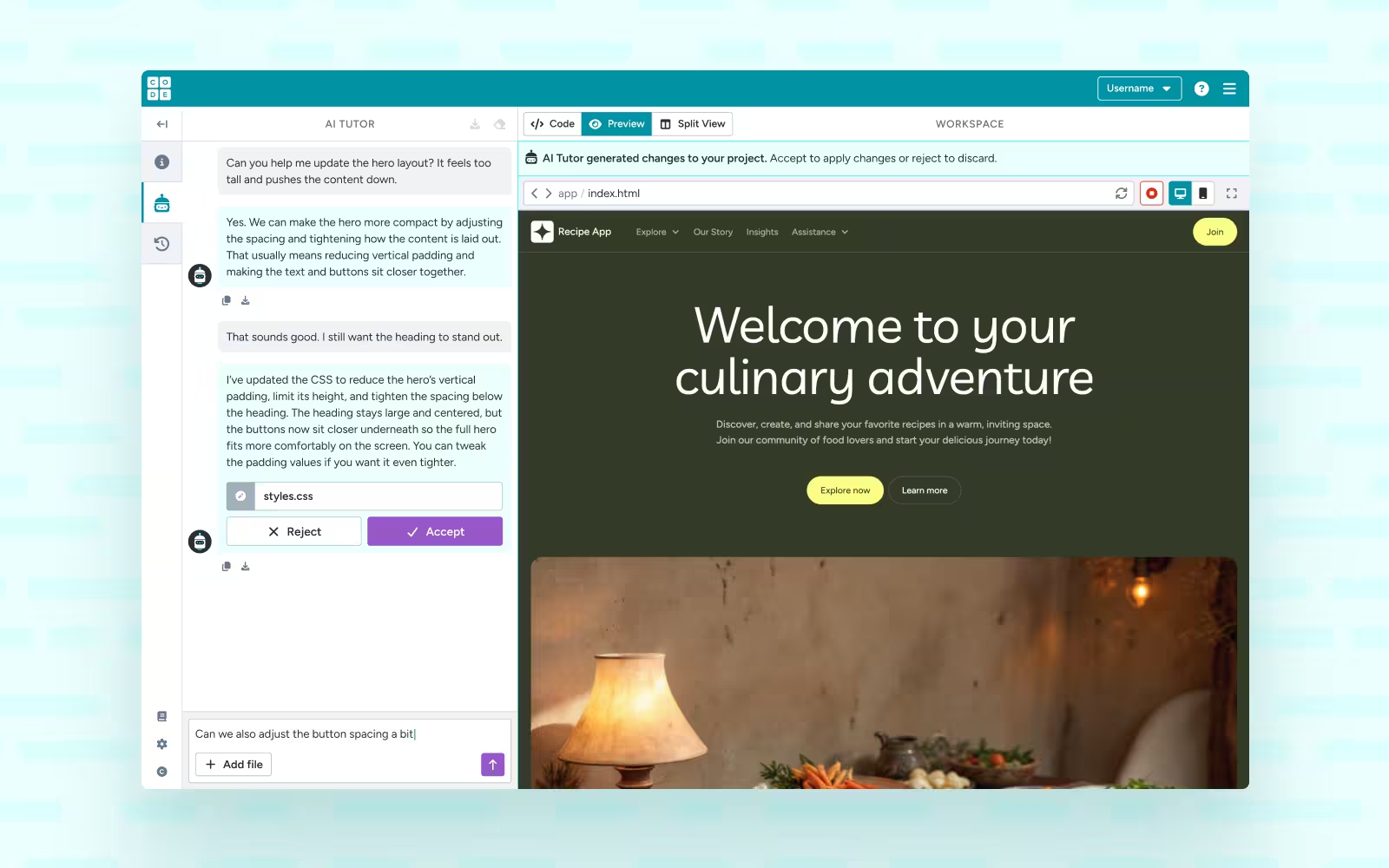
The editor, output, lesson, and tutor become one learning surface.
That matters because the assistant can respond to the actual artifact and task instead of forcing the student to copy context into a generic chat window. The current Web Lab experience supports HTML, CSS, and JavaScript, with AI Tutor built into the workflow.
Curriculum became an action space the model could read.
I translated modular curriculum into an LLM-interpretable action space. The product problem was to make instructional intent legible to the model: what the student is working on, what the lesson is trying to teach, and what kind of intervention is appropriate now.
The loop mattered more than the answer.
The current Intro to Web Lab lesson makes the intended behavior visible: students start with a vision, let AI produce a first draft, notice the mismatch, investigate HTML/CSS concepts, debug and refine, then return to the original page with better judgment.
Product strategy across the student and teacher sides.
My role covered the broader AI learning system, not only a chat interface. I led cross-functional strategy and launch work across AI Tutor and Teaching Assistant while the organization was adapting its curriculum and tools to an AI-native learning model.
AI Tutor + Teaching Assistant
Led cross-functional product strategy and launch to 100K+ teachers, supporting adaptive K–12 curriculum.
AI should tighten the feedback loop without making the learner disappear.
The useful question is not “can the model do this?” It is “what should the person understand or decide after the model does its part?” In learning products, that distinction is the product.
← Back to portfolio